

الوظائف ذات الصلة
مخزن الرحلان الكهربائي السريع: اجعل الجل نقطة تفتيش، وليس خطوة انتظار
2026-08-19Agarose gel Electrophoresis is not the end of the experiment.
More frequently it's in the middle.
You perform a PCR, run a gel and determine if the PCR product should be purified. You digest a plasmid, look at the bands and then decide whether to proceed. You prepare samples for sequencing, run another QC gel and make decisions on what to proceed.
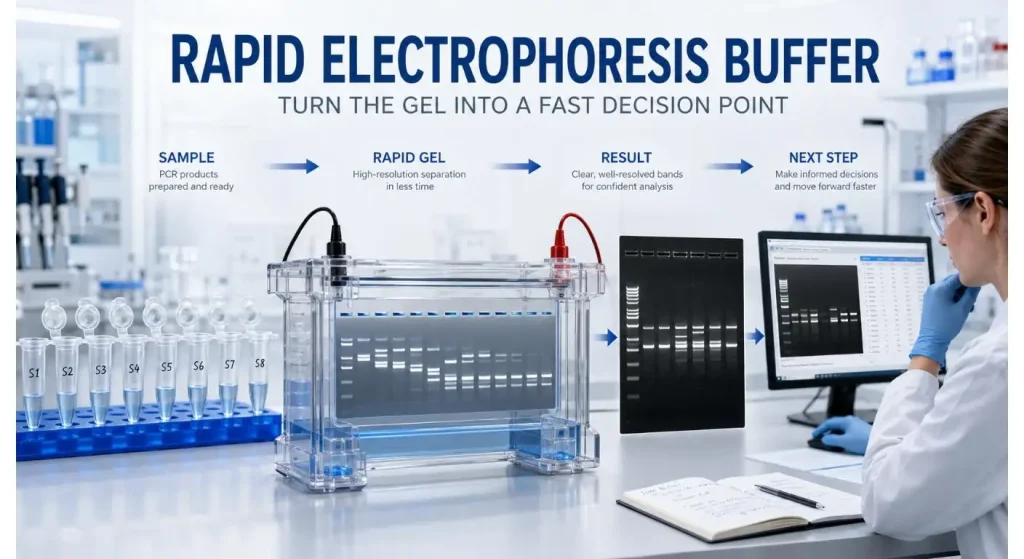
This is why sitting and waiting for electrophoresis can seem like a very long time. Nothing will move downstream till you see the bands, although the gel can take only half an hour.
The major advantage of a rapid electrophoresis buffer, therefore, is to shorten that decision loop—not just to speed up the migration of DNA.
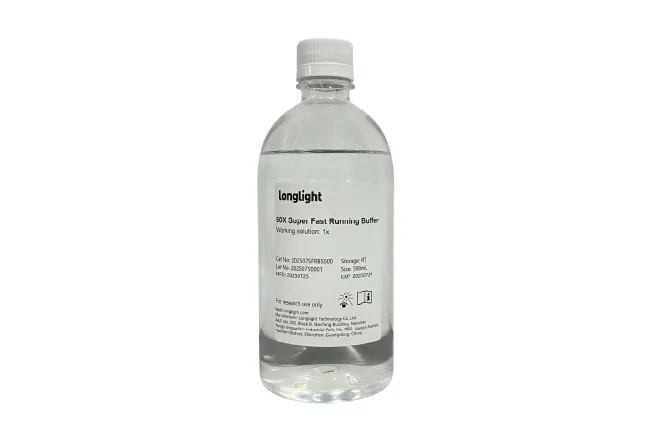
Longlight's 50X عازلة فائقة السرعة is a low-ionic-strength agarose electrophoresis buffer that provides fast DNA separation. It can typically perform typical separations in 5-10 minutes, instead of 30 minutes under the recommended conditions.
If you're not sure about the bands, a five-minute gel isn't worth it.
Speed alone is not a desired output.
If the gel doesn't turn out, then it's a five minute repeat gel and it's no longer a five minute experiment.
Even for common molecular biology applications one needs to differentiate the bands to make the next decision: Was the expected product generated in PCR? Does the insert exist? Are they suitable for recovery of DNA? Is there anything else you need to do with the sample?
The fast running buffer is compatible with agarose concentrations of 0.8%, 1% and 2% and clear separation of the nucleic-acid bands was achieved in these gels, according to Longlight.
Thus, the right target is not the maximum migration speed.
It's the minimum run that is sufficient to make a decision.
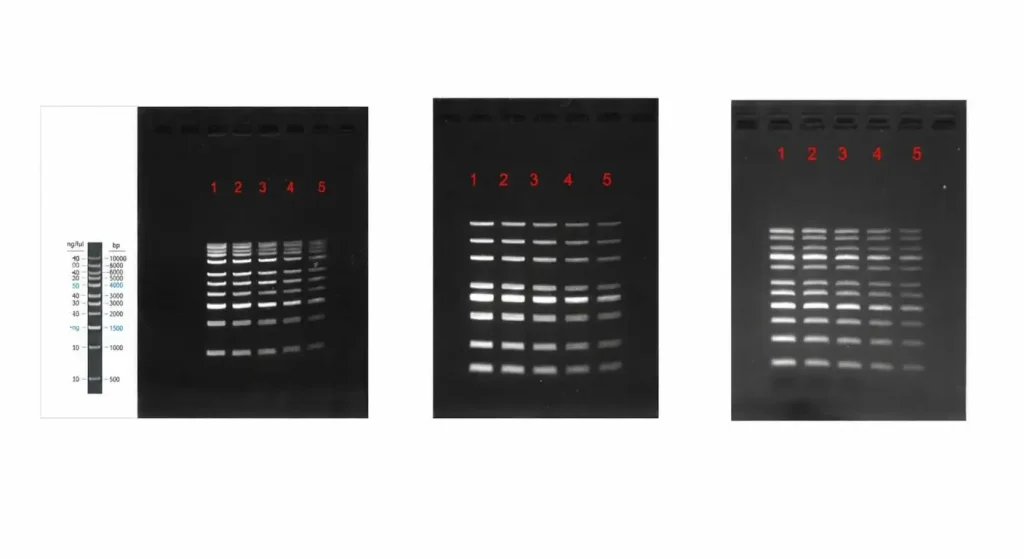
The voltage window that is useful is altered by low ionic strength changes.
It's easy to see that there is a limit to increasing the voltage to make a conventional gel faster: heat.
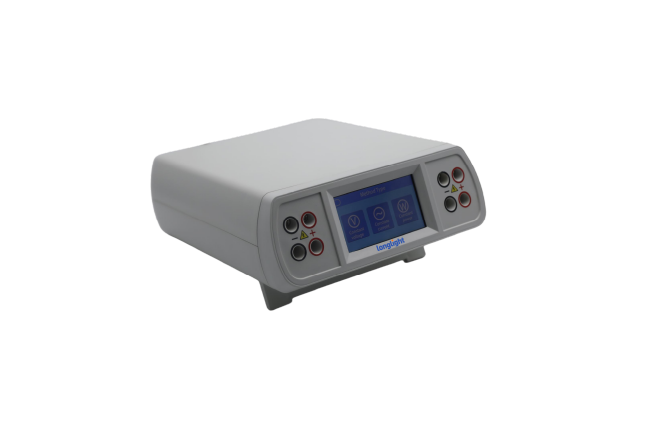
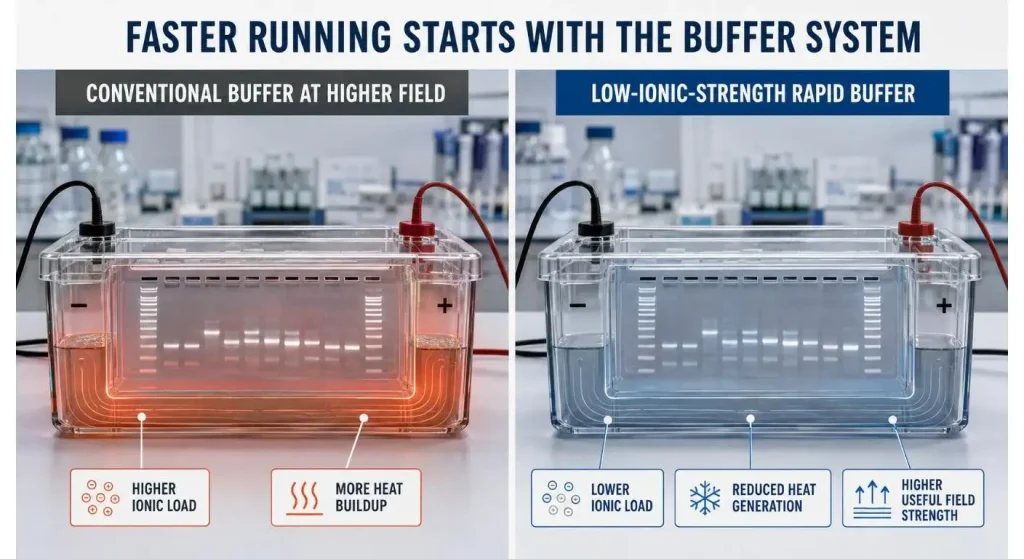
The predictability of migration and band shape may deteriorate with increasing current and thermal load. A rapid running buffer on the other hand tackles the problem from a different perspective by decreasing the ionic strength, thereby reducing the heat generation and allowing a higher electric field to be used during separation. According to Longlight, the gel length of 1X working buffer is about 25–30 V/cm, depending on the geometry of the electrophoresis tank and the temperature of the environment.
That distinction matters.
“Fast electrophoresis” does not refer to the use of a higher voltage until something goes wrong.
It should imply the use of a buffer and operating window which were designed to work together.
The 1X Buffer is considered part of the Method.
A concentrated stock seems like a simple concept: dilute and run.
Here, small laboratory shortcuts can introduce unwarranted variation, too.
The rapid buffer supplied by Longlight is supplied as a 50X concentrate which is diluted 1:50 in distilled water to make the 1X working solution. The company does not suggest that different buffer conditions should be made between gel and tank, and it is recommended to use the same batch of 1X solution for both gel casting and electrophoresis. Dilution below 1X is also not recommended as abnormal migration may occur.
Once a quick gel procedure is successful, add it to the SOP.
Avoid leaving it as something that “everybody in the laboratory” “roughly knows.”
| Setup Item | What to Standardize | Common Risk |
| Stock Dilution | 50X → 1X | Incorrect buffer strength |
| Gel Buffer | Same 1X working batch | Different ionic conditions |
| المخزن المؤقت الجاري | Same 1X working batch | Migration inconsistency |
| Gel Length | Record actual length | Copying an unsuitable voltage |
| درجة الحرارة | Check during rapid runs | Excessive heating |
| Buffer Reuse | Define replacement rule | Run-to-run variation |
| QC Result | Band clarity and migration | Speed without usable separation |
Don't copy voltage from someone else's tank!
Without gel length, the voltage value is incomplete information.
It is useful to think of the run in terms of field strength, as the ratio of distance to time is not the same for a compact electrophoresis chamber as for a longer gel.
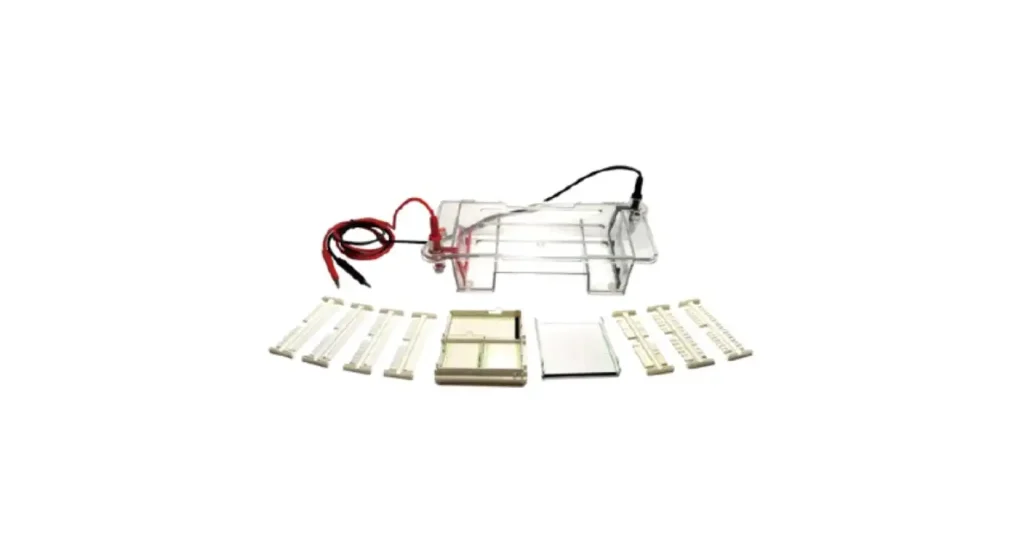
That's why Longlight has specified the range of operation per centimetre of gel. It can also accommodate several kinds of trays such as short, long, wide and larger gels, which is why one memorized voltage should not simply be transferred from one set-up to the next, with its نظام الجل الأفقي HE-50.
Begin with a "field strength" verified and observe the "actual gel".
Temperature, tank design and the power supply limits are still an experiment.
Rapid Electrophoresis When the Decision is Easy
All gels don't have the same task.
Detailed analytical separation is sometimes required by researchers. Another bench is just to see if a PCR product is obtained at approximately the correct size.
The second is a case in which it is the concept of rapid electrophoresis that is especially useful.
Many little snags can occur throughout a working day with PCR verification, clone screening, restriction checks and intermediate DNA QC. Those checkpoints can be shorter if they do, which means that the researchers can make a number of experimental decisions in one afternoon instead of waiting for repeated conventional runs.
These routine checks can be further simplified by use of a ready to use DNA Marker, as Longlight's markers have been supplied with loading buffer and are designed to be used directly in agarose electrophoresis.
The idea is NOT to standardize every electrophoresis experiment.
It's important to understand which gels are truly built to answer a fast query.
The time saver process doesn't continue until the next step is ready.
Imagine doing electrophoresis for 8 minutes and then having to prepare all the things in the subsequent step for another 20 minutes.
The buffer was speedy. The workflow was not what.
Where surrounding steps are taken into account, rapid electrophoresis is the best method. According to Longlight, its Super Fast Running Buffer will not interfere with downstream workflows; DNA gel extraction and ligation can be performed on DNA recovered in the Longlight buffer.
If gel preparation time is also a constraint for the laboratory, then another option is to use Agarose جل مسبقة الصب, which are already prepared for loading and are not subject to the traditional gel preparation time.
This is where several little time savings become a real time saver in bench work.
Imaging is the next step that slows the Gel Gets Faster
When one step in a laboratory process is accelerated, a familiar thing happens.
All of a sudden, you're aware of how long the next one is.
When the separation is completed in a few minutes, the time to remove the gel, set up illumination, adjust exposure, identify the ladder and save the images may be a larger percentage of the total turnaround time.
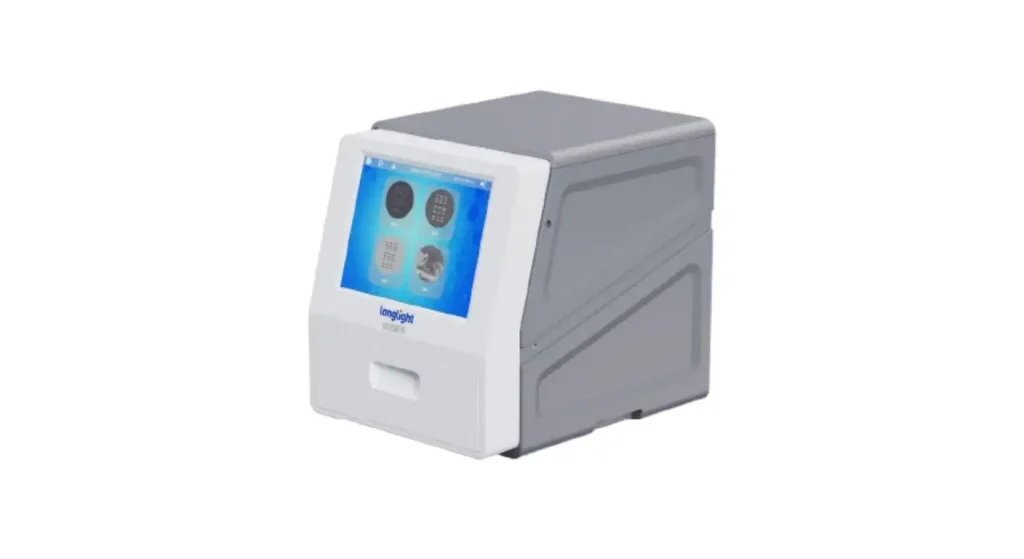
With the built-in image processing and automatic marker annotation, Longlight's GI-200 Gel Imaging System is applicable to laboratories seeking applications beyond only the time of the electrophoresis run.
| Workflow Stage | Question to Ask |
| Gel Preparation | Is casting now taking longer than the run? |
| Sample Loading | Is manual loading limiting batch speed? |
| Electrophoresis | Are conditions already validated? |
| Staining | Is staining inside the gel or performed afterward? |
| Imaging | How quickly can bands be documented? |
| Band Interpretation | Can the ladder be identified efficiently? |
| Downstream Step | Is purification or ligation ready to start? |
It is therefore important that a rapid buffer does not be evaluated separately.
Measure the duration of the workflow, from introducing a sample to when you can make the next decision about an experiment.
Present evidence that reusing water is safe.Provide proof that reusing water is safe.
Longlight states that the buffer has enough buffering to be able to be used multiple times, but not an infinite amount of times.
The working environment may change with back to back electrophoresis, warm room conditions and with accumulated use. Therefore, according to the manufacturer's instructions, the running buffer should be replaced from time to time to ensure the reproducibility.
Now is the time for an easy lab rule.
Determine when the buffer needs to be replaced, rather than wait until a "weird looking gel" reminds you that it's time to change it.
Final Bench Check
When considering using a rapid electrophoresis buffer in routine laboratory use, be sure to validate the buffer with the samples the laboratory uses to process.
Make up the appropriate 1X solution. Casting and running should be done in the same working buffer. Choose the field strength based on the length of the gel and the tank conditions. Watch temperature. Ensure bands produced are sufficient for decision to be made.
Then measure something other than electrophoresis time, something useful:
Loading the sample to determining what to do next?
This is where Rapid Electrophoresis has its role in the lab.
الأسئلة المتداولة
Q1. What is meant by rapid electrophoresis buffer?What is the term 'rapid electrophoresis buffer'?
Running buffer designed to allow more rapid separation of nucleic-acids in agarose gels. Longlight's version is formulated with low ionic strength that allows for greater field strengths with reduced heat generation.
Q2. How fast may rapid electrophoresis be?How fast can rapid electrophoresis be on the other hand?
Longlight typically achieves separation times of about 5 - 10 minutes under recommended conditions versus about 30 minutes for conventional separation runs. Actual performance will be dependent on gel length, tank design and operating conditions.
Q3. What is the concentration of the running buffer for 50X?
The concentrate is diluted 1:50 with distilled water to make a 1X working solution. Preferably, the same batch of 1X should be used for making the gel and filling the running chamber.
Q4. Is there a need to use running buffer at a higher speed prior to the gel extraction?
According to Longlight, the Super Fast Running Buffer can be used for DNA gel extraction and ligation, enabling samples to be used in standard downstream applications.
Q5. Can rapid electrophoresis buffer be reused?
The product has buffering capacity for reuse, but it is recommended that the product should be replaced periodically to ensure the accuracy and the reproducibility. The temperature, as well as repeated running conditions should also be monitored.
